• What’s in My Concert Bag? A Fangirl’s Essentials

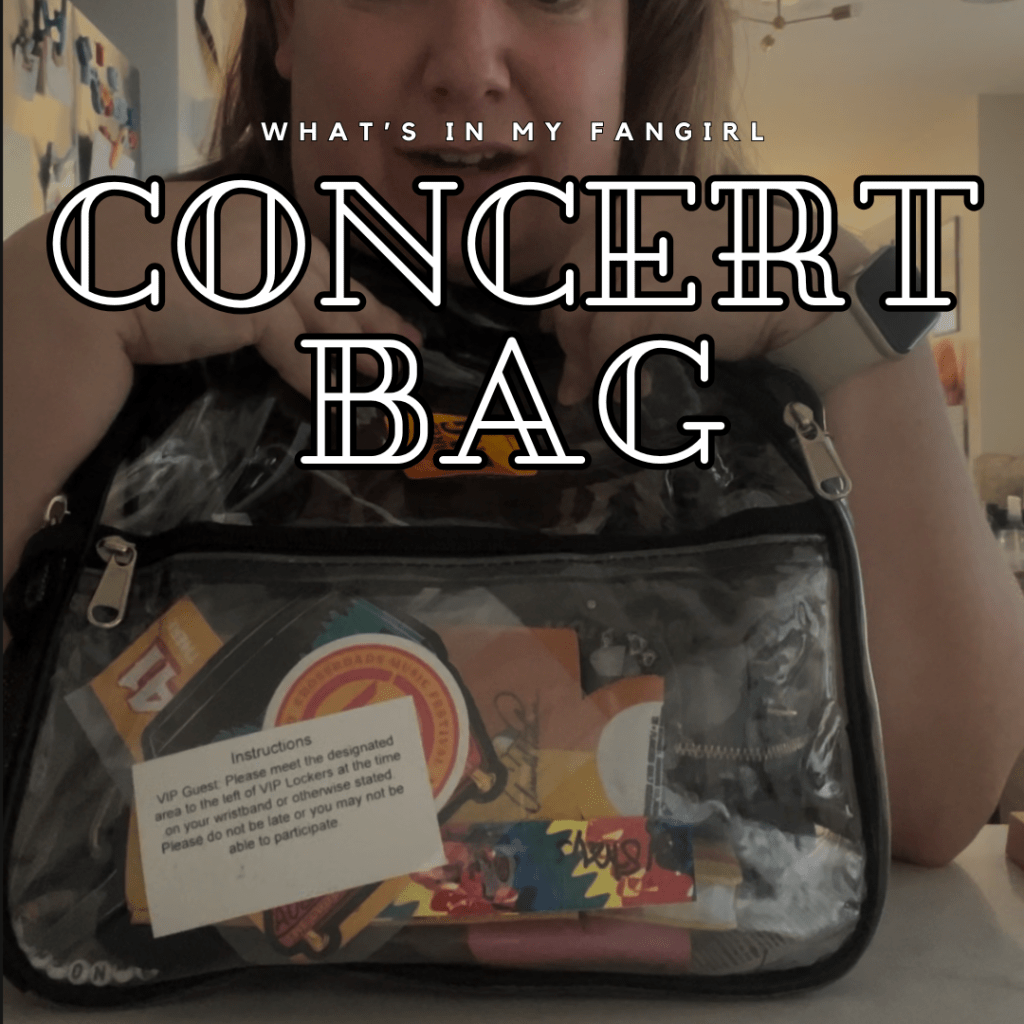
    I am a fangirl first and foremost. Between working the digital media side of live events to sneaking my way to the front to the pit on my own, I’ve mastered the art of packing the perfect concert bag to ensure I’m prepared for anything and everything. Whether you’re headed to a local show or a multi-night run of your favorite artist (in this case, Hanson’s two-night run in Nashville), here’s a guide to what I always bring to ensure an unforgettable night.

    The Concert Bag

    Let’s start with the bag itself. The real MVP move is ensuring it meets the venue’s bag policy. Always double-check the policy because no two venues are alike. Nothing derails a night of fangirling faster than being told your bag is too big or not transparent enough. My go-to is a small clear backpack that meets most venue bag policies. A small backpack is perfect for stashing everything you need while also leaving room for merch (because no one wants to juggle a merch bag all night). Bonus points if your bag has some character! Mine are still sports stickers and clearance tags from past shows, which feel like a mini time capsule of my concert adventures. Just make sure security can still see inside of it.

    What’s Inside? Let’s Dive In!

    1. Selfie Ring Light

    This little gadget is a lifesaver—not for the show itself (please don’t be that person blinding everyone with your ring light mid-song), but for snapping pre-show selfies with your friends or finding something you dropped in a dimly lit venue. Bonus: It saves your phone battery for more important things, like taking 87 blurry pictures and 3 good ones of the band.

    2. Chapstick

    Concerts are dry. My lips deserve hydration while I’m belting out every lyric.

    3. Wallet

    The essentials: ID, credit cards, and maybe some cash for merch or drinks. I strongly recommend a wallet that can double as a bag in case you have to ditch your bigger bag at the gate.

    4. Koozies

    I love picking up event-specific koozies, but I also bring my own, just in case. It’s the little things that elevate your concert drink experience. Plus, nobody wants wet hands.

    5. Notebook and Pen

    Call me old-school, but I always have a notebook and pen. Whether I’m jotting down setlists, random thoughts, or fangirl doodles, they’re a staple in my bag.

    6. Lens Wipes

    This is for clear phone camera lenses and even clearer views of the band. Pro tip: clean your lens before snapping pictures—it makes a world of difference. Wipe off your front AND back cameras.

    7. Hand Sanitizer

    Concerts are fun but also gross. Enough said.

    8. Portable Charger

    This old-school Apple Charge Brick has been my trusty companion for many shows. It’s a must-have to ensure my phone lasts through the night (and all my Instagram Stories).

    9. Friendship Bracelets

    Even if you’re not a Swifty, you kinda gotta love the tradable nature of friendship bracelets. I enjoy making them for myself and concert buddies. They make for great accessories for detailed shots and are a great way to make some friends; especially with bar staff.
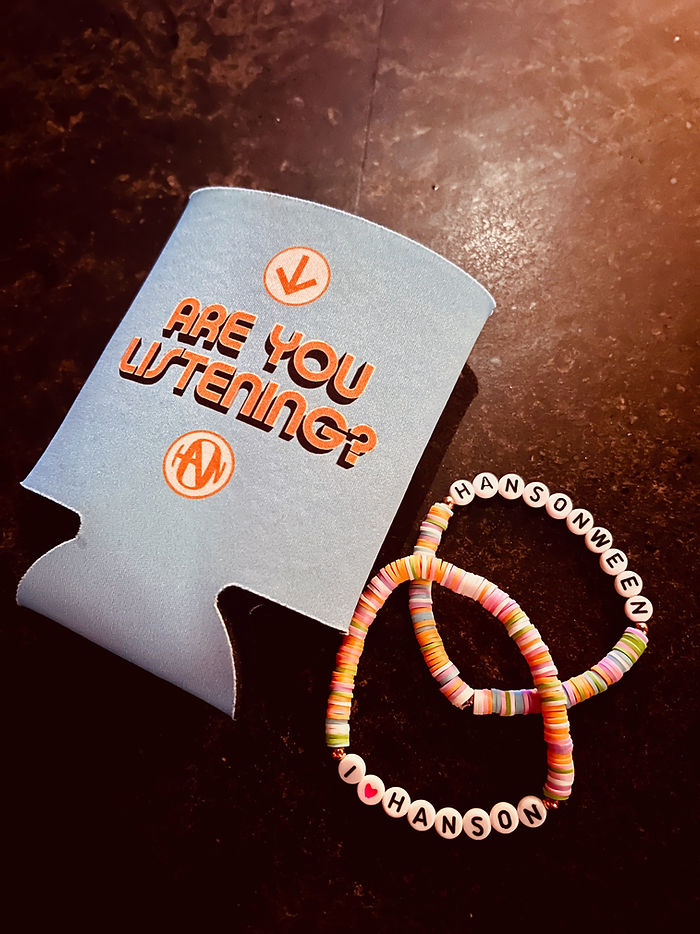
    A photo of a Hanson drink koozie that says "Are You Listening" and two beaded bracelets that say I *heart* Hanson and Hansonween
    Detail shots are some of my favorites.

    10. Extra Hair Tie

    Concert venues get hot. At some point, my hair is going up. Bring more than you think you’ll need.

    11. Snacks

    Because hunger waits for no fangirl, and you can’t cheer with a growling stomach. I’ll usually stash something easy to carry, like granola bars or leftover Halloween candy.

    12. Cough Drops

    Even if it’s an acoustic show, I’m probably gonna end up scream singing. My vocal cords need all the support they can get.

    13. Sharpie

    You never know when you might need it—autographs, notes, helping out a fellow fangirl. It’s the Swiss Army knife of concert accessories. Just be prepared to part ways with it if need be.

    Ready to Rock

    And that’s my bag, perfectly packed for any concert. Whether singing along in the front row or hanging in the back, soaking up the vibes, being prepared makes every show more enjoyable.

    So, what’s in your concert bag? Let me know in the comments below—I’m always looking for new ideas to add to mine!
    @fabkiwi06

    This video might be over a month old but it’s still sound advice. There’s more on the blog- kiwibailey.com #concert #whatsinmybag #fangirls

    ♬ original sound – Kieran ‘Kiwi’ Trask
  • Why Millennium Defined a Generation’s Sound

    1999 was a pivotal year for pop music in my life.

    I was 10, about to be 11. We had gone on an extended trip to my grandmother’s house in St. Paul, Minnesota. I was flipping her old (even for that time) bunny-eared TV to the UHF channel, and adjusting the antenna to get The Box to come in. You don’t remember The Box? It was a channel you could call on a 900 number to request music videos. It was a whole thing… the 90’s were a wild time. Anyway, I would have to sit “just so” in front of the TV to get the best reception, and I would wait for other people to call in. And that’s when I saw it for the first time.

    When I tell you that my first listen of I Want It That Way is one of the core experiences of my life, I want you to take me so seriously. I remember this first so clearly, the same way you would remember a first kiss or winning a major award as a child. It was like I gained consciousness in that moment… There had been nothing before, and now there was only this sparkly pop synth beat and AJ McLean ad-libbing “ye-eh-eah”. And I know you read that last bit in his exact inflection because that’s how deeply embedded I Want It That Way has become in our pop culture collective.

    Later that day, we went to the mall, and I wasted no time getting myself to Sam Goody to get my hands on this album so I could hear that song again. Y’all… I bought it on cassette tape because I didn’t want to wait until we went back home later that week to listen to the CD, and I had an old, busted-up Walkman with me. And when I say I had it with me, I mean I had brought it to the mall because I did not want to wait one second longer than I had to before I could push that play button.

    I spent the rest of that trip either sitting on the back step meticulously rewinding and memorizing every single lyric uttered on that tape, or covertly sneaking AA batteries out of various appliances so I could keep sitting on the back step memorizing every lyric.

    This wasn’t my first encounter with boy bands; Hanson got me well down that path a few years before. Backstreet Boys were also already pretty heavy in my rotation at that time. Millennium hit different, though.

    This was THE album of the moment, kind of perfectly encapsulating what was going on in music at that time. It was the prime era of MTV, multi-million-dollar music video shoots, teen magazines, and pop radio. We were coming out of our grungey, hippy-revival funk and looking to the future. That future was bouncy, optimistic, and, for some reason, a shiny baby blue. A lot of songs were about love, of course, but in earnest. Life was a rom-com, and this was the backing track. Your school crush might not notice you, but these five conventionally attractive young men are singing about how you are their fire… their one desire.

    This was a pivotal time in my life. 1999 was the summer I went from a kid to a preteen. There were major life changes at home, with my stepdad entering the picture. I went from thinking boys were gross to thinking maybe not all of them were gross. MTV became my go-to channel. I started to care about who was hosting and performing on SNL. We spent part of the summer in the deep woods, where I would walk up and down a dirt road trying to get a radio signal to listen to Casey Kasem with little luck. I listened to a lot of Millennium since it was the only cassette I had of “my” music. I had teen angst without much to be angsty about, so I projected my emotions onto the perceived love dramas playing through my headphones.

    This was a pivotal time for the Backstreet Boys as well. For those not up on their BSB lore, this was the first album post-Lou Pearlman. They had left their record label and management team, with whom they had been since ’93. They had two successful European releases and had just cracked the US market. NSYNC was hot on their heels (and also part of the Boyband Con). There was a lot riding on this album, and to have it perform well was a make-or-break moment for the band. And it did perform well, setting sales records at the time and continuing to rank among the best-selling records of all time.

    Millennium is a good pop album, even when you take the nostalgia goggles off. It’s ranked among the best-selling albums of all time. It’s got pop production icon Max Martin involved in 7 of the 12 songs. It was nominated for some Grammys and lost most to Santana. Show Me The Meaning of Being Lonely is tragically beautiful. Moms get a shoutout in The Perfect Fan. Back To Your Heart is the breakup song we all want to be written to us. It’s not deep or thought-provoking, but it’s damn catchy with some poignant lyrics that hit you when you least expect it.

    25 years later, I Want It That Way still holds up. Recently, I was at a Taylor Swift-themed silent disco that had a headphone channel of general pop hits you could switch to. Somehow, the crowd of mostly Gen Z & Alpha Swifties all switched to that channel at the same time and scream-sung every word to I Want It That Way as if it were a middle school dance in 1999.

    Here’s to you, Millennium. You were a canon event in my life and the first album I actually wore out listening to. You continue to be the touchstone for all pop music I discover. Talking about you makes me feel my age, but listening to you makes me feel like I’m 11 again. I will always love you more than No Strings Attached.

    KTBPA ❤️

  • Should I Post My Content During Major News Events?

    Imagine: You are someone who needs to post on social media. Maybe it’s for your small business. Perhaps you’ve managed to make your online presence your full-time job. Maybe you’re just minimally maintaining your account. Idk, you know what bucket you fall into.

    As you go about your otherwise unremarkable day, you get the notification. A “Big Thing” has happened. It could be a death of a world leader. It could be an uprising at your nation’s capitol. It could be a major weather system causing catastrophic damage. The specifics don’t really matter. What DOES matter is that the clever interpretive dance you filmed to the recharting 90s sleeper hit suddenly seems very out of place and thoughtless to post.

    What do you do?

    This situation happens a lot more than you would think, especially in the era of the 24-hour news cycle. As important as maintaining your online presence is, your account does not exist in a vacuum. Sometimes your perfectly scheduled feed gets thrown out the window because of the next Breaking News alert. How do you know what to ignore, when to lean it, and when to hold posting? Major news events tend to fall under three main categories; Emergency Situations, Notable Deaths, and WTF Is Happening. Like with all answers in life, how you respond to these depend on context. Here are my general guidelines for deciding how to work around major “real world” events in a content calendar.

    Emergency Situations

    What Is It?: An Emergency Situation is something that is impacting a great number of people in a clearly dangerous way. Examples are things like mass shootings, major earthquakes, civil unrest… anything that people are going to want or need to pay attention to trusted sources of information in order to keep themselves safe or informed. These can be from worldwide events to hyper-local situations.

    Should I Post?: If this is a life-altering event that impacts you, your followers, or the good of humanity, hold your posting (unless your posts are providing information and updates from reliable sources or you are the reliable source). A, people aren’t going to be watching your resin pour videos at that second anyway and B, you don’t want to be the asshole talking about resin ashtrays when there is an actual crisis going on.

    If You Must Post: Sharing information from reputable sources and amplifying the voices of the people who are impacted is encouraged. Just make sure you attempt to check that the information you share is accurate and legitimate. No FakeNews.

    Notable Deaths

    What Is It?: A notable death is when someone well-known and influential shuffles off this mortal coil. Examples include major heads of state, beloved celebrities, or local people of importance. This can be subjective; The Queen’s passing was a noted event worldwide, but the impact was quite different for the UK than it was for the US. Celebrity deaths and their impact are going to depend on demographics.

    Should I Post?: Your posting options are going to depend on your followers, the magnitude of loss felt by this passing, and if you are running a personal or public account. If your audience is going to be paying more attention to the news reports or tributes coming in, hold your witty standup routine until their focus shifts back.

    If You Must Post: If you are running a business account or any sort of large public-facing account, consider if a tribute post is appropriate and confirm that any of your previously scheduled content isn’t going to be constructed as insensitive. If you are running a personal account, you can carry on as normal but don’t just post a tribute to get the engagement. There’s nothing cringier than claiming to be the biggest fan of someone who passed and then talking about how much you loved the band that they weren’t even in. However, a heartfelt tribute to someone who inspired you is something that can help build your authenticity.

    WTF Is Happening?

    What Is It?: Sometimes shit just happens and all you can say is “what the fuck is that”. The Oscar host gets slapped for a bad joke on live TV. The former President’s lawyer holds a press conference at a landscaping lot. The hot tech company launches a much anticipated new product with a funny name. Usually, these moments don’t have the same sense of urgency or gravity as the previous two, but they are pulling a majority of the day’s focus.

    Should I Post?: This is going to be highly dependent on your audience, strategy, and personal preferences as well as the actual event that is going on. If you are running a public-facing account for a business or brand I would urge you to think hard about running with anything that is controversial or political unless that is a stance you are comfortable defending. Otherwise, if you think you can hold your own, save your evergreen content for when you need to fill a void and Lean In. These are literally the moments that social media was made for. If you are watching it happen, are willing to take the risk that not 100% of your audience will agree with you, and have something to say, do it.

    If You Must Post: Be witty but don’t try too hard. Credit your memes if you’re resharing. Be prepared to handle the backlash if it doesn’t land. Enjoy the ride, but don’t be the account that drags the moment out beyond its expiration date.

    Final Thoughts

    As always, the biggest rule is that there are no hard and fast rules. Flexibility and overall awareness are what save the day in these situations. If it feels right to post, or not post, your instinct is often correct. If you know your audience, know your strategy & posting schedule, and have a spoonful of common sense, you can negotiate your way through without having your account look out of touch or insensitive.

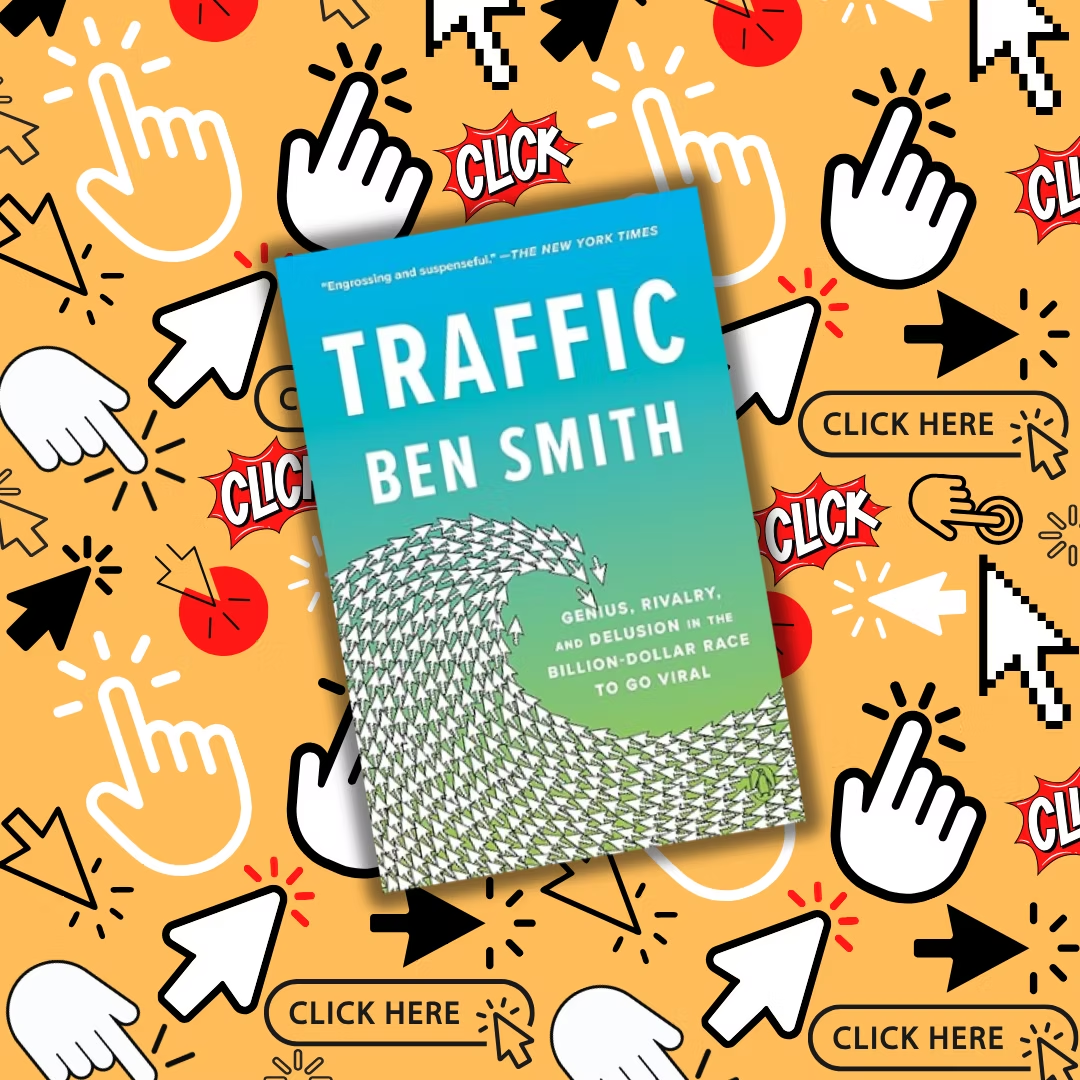
  • Traffic by Ben Smith: How the Wild West of Digital Media Shaped Today’s Content Culture

    If you’ve ever fallen down the rabbit hole of PerezHilton, Gawker, or Buzzfeed back in the early days of the internet, Ben Smith’s Traffic will feel like stepping into a time machine. As someone who remembers devouring these sites in their heyday—and now works as a digital marketer chasing the same algorithmic highs—this book struck a perfect balance between nostalgia and insight. Smith doesn’t just recount the history of the digital media boom; he dissects how it shaped today’s content culture. For marketers, pop culture enthusiasts, and internet nerds alike, Traffic is an essential read.

    The Wild West of Content Strategy

    One of the most fascinating aspects of the book is how it explores the early days of digital media as a free-for-all, where strategy shifted on a dime, and audiences were notoriously fickle. It’s a theme I see echoed in my work as a marketer: the need to adapt quickly because what worked yesterday might be irrelevant today. Smith’s narrative shows how digital giants like Buzzfeed and Gawker rode the wave of the Facebook algorithm—something I’ve experienced firsthand, working to game algorithms to drive website traffic. It’s a game of constant reinvention, and Traffic lays out just how high the stakes were for those early players.

    The Drama Behind the Clicks

    Beyond the data and strategies, the book humanizes the players involved, from complicated alliances to the personal rivalries that fueled the industry. The section on Andrew Breitbart’s complicated loyalties to Matt Drudge while helping launch Huffington Post was particularly compelling. Smith paints him as a surprisingly sympathetic figure despite my own… complicated… feelings about him. Likewise, the slow-burning saga of how speculation around Peter Thiel’s personal life showing up in Gawker ended up being the key behind the site’s downfall. The interwoven respect and simmering resentment among these media pioneers—whether allies or competitors—make for a compelling narrative that’s as much about human drama as it is about business.

    Lessons for Today’s Digital Content Culture Landscape

    As marketers, we often focus on creating content that sticks—but Traffic is a reminder that virality isn’t always about quality. It’s about understanding your audience and delivering what they’ll click on. The book offers a deep dive into the churn of content required to keep audiences engaged, and its lessons are still relevant for anyone in the industry today. From finding the hook to keeping audiences coming back for more, it’s a masterclass in audience retention—even if some of the platforms mentioned (hello, Facebook’s golden age) feel like relics now.

    What I Wished for More Of

    While Smith does a fantastic job laying out the big picture, I would have loved a deeper dive into the methodology. How did strategies subtly shift across different platforms? What did Twitter engagement look like compared to Facebook or Reddit? These nuances could have added even more layers to the story, especially for those of us who geek out over platform-specific insights.

    Why You Should Read This Book

    Whether you’re a marketer looking to understand the roots of today’s content culture or a nostalgia-driven internet nerd, Traffic offers a compelling look at how the digital media landscape came to be. It’s an origin story for the virality we’re all chasing, and it’s packed with lessons for anyone who wants to keep an audience engaged—whether you’re creating clickbait or crafting meaningful campaigns.

    For marketers, it’s a lesson in agility. For sociologists, it’s a study of how online culture evolved. And for anyone who spent their mornings refreshing Gawker or Buzzfeed, it’s a nostalgic deep dive worth taking.

    Book Info:

    Title: Traffic: Genius, Rivalry, and Delusion in the Billion-Dollar Race to Go Viral

    Author: Ben Smith

    Amazon | Audible | Bookshop.org